
Great Reef Dwellers: The California Spiny Lobster
By Patrick Dean. August 5, 2026
When we think about reef dwellers, we often picture fish moving through kelp, hiding in rock crevices, or hunting along the edges of a reef. But some of the most fascinating animals on a reef do not swim like fish at all.
- They walk.
- They crawl.
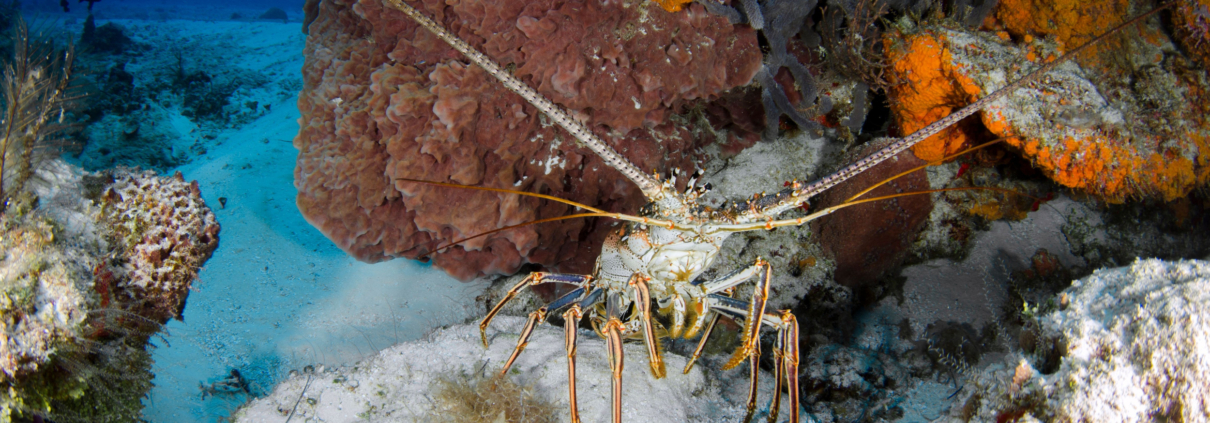
They hide in caves during the day and come out at night like armored explorers. One of the most amazing reef dwellers of Southern California is the California spiny lobster. Its scientific name is Panulirus interruptus, and it is one of the most recognizable animals in our coastal reef and kelp forest ecosystems.
Unlike the Maine lobster that many people picture when they hear the word “lobster,” the California spiny lobster does not have large front claws. Instead, it has a hard armored body, powerful legs, sharp spines, long antennae, and a strong tail that can launch it backward through the water when danger appears.
The California spiny lobster lives along rocky reefs, kelp forests, caves, ledges, boulder fields, and coastal habitats from central California down through Baja California. In Southern California, it is especially connected to the kind of reef habitat that AnEcoScape is working to restore and create.
This makes the spiny lobster a perfect animal for our “Reef Dwellers” series. A reef that can support California spiny lobsters is not just a pile of rocks. It is a living neighborhood. It has hiding places, food, water movement, algae, invertebrates, fish, predators, and enough structure for animals to survive, grow, reproduce, and take their place in the ecosystem.
A Lobster Built for the Reef
The California spiny lobster looks like it was designed by nature to live in the rocks. Its body is covered with a hard outer shell called an exoskeleton. This shell protects it from predators, but it also means the lobster has to molt as it grows. Molting is when the lobster sheds its old shell and forms a new, larger one. For a short time after molting, the lobster is soft and vulnerable, so hiding places are especially important.
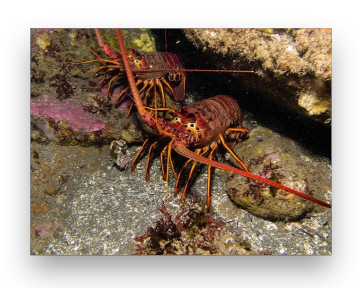
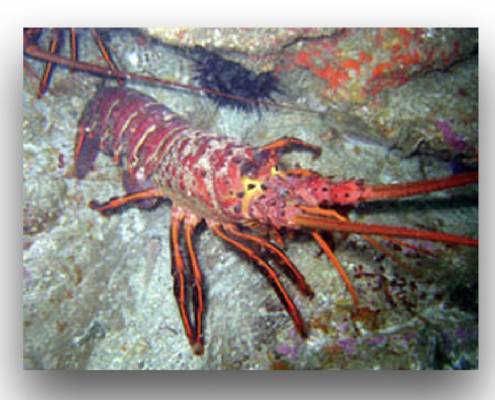
That is one reason rocky reef habitat matters so much. A spiny lobster needs cracks, caves, ledges, and protected spaces where it can stay safe during the day. Divers often see only the tips of its long antennae sticking out from under a rock.
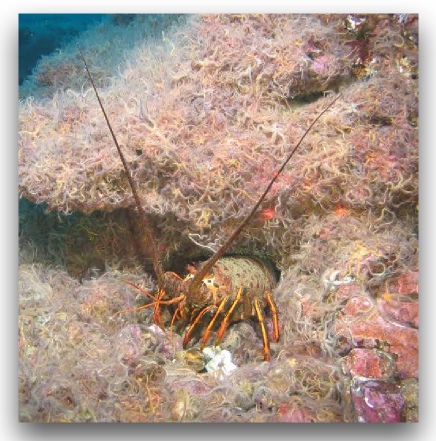
But if you shine your light carefully under a ledge, you may suddenly see several lobsters packed together, facing outward like a small army guarding the entrance.
Spiny lobsters are often social animals. They may share dens with other lobsters, and divers frequently see them in groups.
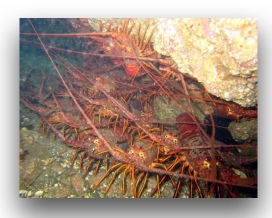
Sometimes there may be two or three together. Other times, there may be ten or more under the same ledge. To a young diver, seeing a group of spiny lobsters tucked into a reef cave can feel like discovering a secret underwater club.
Expand on this topic with one more sentence about their social behavior and living habits.
The California spiny lobster looks like it was designed by nature to live in the rocks. Its body is covered with a hard outer shell called an exoskeleton. Their long antennae are not just for decoration. They are powerful sensory tools. Lobsters use them to touch, feel, sense movement, and explore the world around them. The antennae can also help protect them, because they make the lobster seem larger and harder to attack.
The spine is a defense feature of the exoskeleton. The spiny lobster is not trying to hurt anyone, but to defend against predators, it is definitely built to defend itself. Predators like octopus, sheephead, cabezon, moray eels, horn sharks, leopard sharks, giant sea bass, rockfish, and humans all have an interest in this animal. The California spiny lobster survives by hiding well, sensing danger, and escaping fast when it needs to. One of its best tricks is its tail flip. If startled, the lobster can rapidly flex its strong tail and shoot backward through the water. In one instant it is sitting in front of you, and in the next it is gone.
From Tiny Larva to Armored Reef Dweller
Every large spiny lobster begins life in a way that almost seems impossible. A female California spiny lobster can carry tens of thousands to hundreds of thousands of eggs beneath her abdomen. When the eggs are attached under her tail, people sometimes call her “berried” because the egg mass looks like a cluster of tiny berries.
After the eggs hatch, the young lobsters do not look like little versions of adults. They begin as tiny, transparent larvae drifting in the open ocean. These larvae are called phyllosoma larvae, and they may spend many months floating with currents before they are ready to settle.
- This is one of the most remarkable parts of the spiny lobster life story.
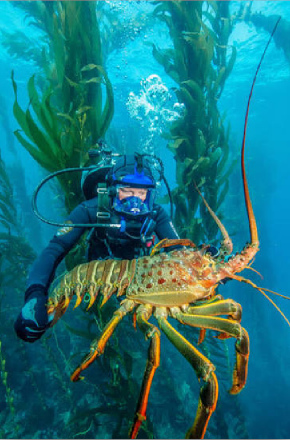
An animal that will one day crawl through a rocky reef, hide in caves, and use its long antennae to explore the ocean floor begins life as a delicate drifting creature in the plankton. It must survive currents, predators, changing water conditions, and an enormous open ocean before it can settle into bottom habitat.
Eventually, the young lobster transforms into a stage called a puerulus. At this stage it looks more like a tiny lobster, but it is still nearly clear. It then finds suitable habitat and begins life on the seafloor.
This is where structure becomes critical.
A young lobster needs shelter. It needs holes, cracks, small spaces, algae, cobble, rocks, and places where larger predators cannot easily reach it. A flat sandy bottom does not offer the same protection. A reef with many openings and surfaces gives a young lobster a better chance.
- That is why artificial reefs can be so important.
When a carefully designed reef creates caves, crevices, ledges, and rocky surfaces, it can become habitat for many stages of life. Small animals arrive first. Algae and invertebrates begin to grow. Fish come to feed and hide. Lobsters discover shelter. Over time, the reef becomes more than a structure. It becomes a working ecosystem.
- For a young lobster, reef structure is safety.
- For an adult lobster, reef structure is home.
A real ‘niche’ or home – a place in the marine ecosystem within the reef.
A Homebody With a Territory
California spiny lobsters are active animals, but they are also deeply connected to shelter. During the day, they usually hide in rocky crevices, caves, and dens. At night, they come out to forage. This is why divers often see them tucked under rocks during daylight hours. But if you could watch that same reef at night, you would see a very different world.
The lobster that was hiding all day may come out and begin moving across the reef, exploring the bottom with its legs and antennae, searching for food.
Spiny lobsters are nocturnal, which means they are most active at night. They may travel away from their daytime shelter to feed and then return to a den before morning. Scientists have found that California spiny lobsters can show strong site fidelity, meaning they often return to the same or nearby shelters.
- This makes good reef design very important.
If a lobster is going to use a reef as part of its daily life, the reef must provide real shelter. It needs ledges, gaps, caves, and protected areas. It also needs surrounding feeding habitat so the lobster can move out at night and find food.
The spiny lobster’s nighttime behavior is one reason it plays such an important role in the reef community. It is not just sitting there looking interesting. It is working.
- At night, it becomes part of the reef’s cleanup and hunting crew.
It eats mussels, clams, worms, urchins, carrion, algae, and other material on the seafloor. It is both a predator and a scavenger. That means it helps recycle nutrients and keep the reef floor from becoming overloaded with dead material. In simple language, the spiny lobster helps clean the neighborhood.
The California Spiny Lobster and Artificial Reefs
Artificial reefs are most successful when they provide the necessary structures the marine animals actually need for their survival and growth. It is not enough to place material in the ocean and hope life appears. A good reef must become useful habitat. For California spiny lobsters, useful habitat means rocky structure.
They need shelter from predators. They need cracks and ledges big enough for adults but also smaller spaces that can protect juveniles. They need nearby feeding areas. They need surfaces where algae and invertebrates can grow. They need a reef that is connected to the larger coastal ecosystem.
- This is exactly why the California spiny lobster is such an exciting animal for AnEcoScape.
A well-designed artificial reef in Southern California could provide the kind of structure spiny lobsters naturally seek. Over time, as the reef becomes covered with algae, invertebrates, and small animals, it can become even more attractive. Lobsters are good at finding shelter, and if the habitat is right, they may begin using the reef as a daytime refuge and nighttime feeding base. This does not mean a reef becomes fully mature overnight. True restoration takes time. But lobsters are exactly the kind of reef dweller that can show us whether the habitat is flourishing.
- If spiny lobsters begin moving into an AnEcoScape reef, that would be a very good sign.
- It would mean the reef is providing shelter.
- It would mean the reef is connected to food sources.
- It would mean the reef is becoming part of the living seafloor.
And because lobsters are important prey for larger animals, their presence can also support the larger food web. A reef with lobsters may attract predators such as sheephead, moray eels, octopus, cabezon, sharks, and even giant sea bass. That is how an ecosystem grows in layers. First comes structure. Then comes life. Then comes the relationship we refer to as an (marine) ecosystem.
A Long-Lived Animal Worth Protecting
California spiny lobsters can live for decades. Estimates of their lifespan range from about 30 to 50 years. That means a large lobster tucked under a reef ledge may be older than many of the people diving above it. This is important because long-lived animals need careful management. The California spiny lobster has been commercially and recreationally harvested for many years.
People value it because it is delicious, and the fishery is culturally and economically important in Southern California. But any animal that is popular to catch needs strong rules to make sure the population remains healthy.
California manages the spiny lobster fishery with seasons, size limits, bag limits, report cards, and gear restrictions. These rules are not just paperwork. They are part of how we protect the future of the species. Marine protected areas also matter. In some areas, lobsters and other reef animals are protected from harvest. These protected places can allow animals to grow larger, live longer, and contribute more to reproduction. For a species like the California spiny lobster, larger females can be especially important because they can produce many eggs.
This is one of the reasons ocean refuge zones and marine protected areas are so valuable. They give the ecosystem a chance to breathe. They give animals a chance to reach larger sizes. They help scientists understand what a healthier reef can look like when fishing pressure is reduced. The goal is not to separate people from the ocean. The goal is to create a relationship with the ocean that can last.
- That means harvest, conservation, restoration, and education all have to work together.
Why This Animal Matters
The California spiny lobster matters because it shows us how alive a reef really is. It reminds us that a reef is not just a place where fish swim. It is a whole community, from tiny larvae drifting in the plankton to large predators moving through the kelp. It includes algae, worms, clams, urchins, fish, octopus, sea stars, sharks, and animals like the spiny lobster that move between shelter and feeding grounds every night.
The spiny lobster is also a great teacher.
It teaches us that structure matters. A small crack in a reef can be the difference between life and death for a young animal. A ledge can become a home. A cave can become a shelter for a whole group of lobsters. A restored reef can become a new neighborhood. It also teaches us that the ocean works best when we think long term. A lobster may live for decades. A reef may take years to mature. A protected area may need time before its benefits are fully visible. Restoration is not instant, but it is powerful.
For young people, the California spiny lobster is one of the most exciting animals to learn about because it is strange, beautiful, tough, social, mysterious, and important. It is an armored night explorer. It is a reef cleaner. It is prey and predator. It is part of the food web. It is part of Southern California’s ocean story.
For AnEcoScape, the spiny lobster represents exactly why artificial reef restoration matters.
When we create good habitat, life has a place to return. One day, a young diver may look under a ledge on a restored reef and see a row of long antennae reaching out from the shadows. Behind those antennae may be a group of California spiny lobsters, safe in their new reef home.
- That moment could spark curiosity.
- It could lead to a love of the ocean.
It could inspire someone to study marine biology, become a diver, support ocean restoration, or simply care more deeply about the natural world. And that is part of the purpose of AnEcoScape: to help rebuild habitat, restore marine life, and invite people of all ages to see the ocean as a living world worth protecting.
Patrick Dean
Associate Writer and Board Member of AnEcoScape NPO
Patrick Dean has a Masters in clinical psychology and is a Life Coach. His work has taken him all over the world and is a strong advocate in preserving our shores, oceans, and aquatic life. Patrick was also a fishing boat captain for over 13 years.
Patrick Dean’s Website
AnEcoScape is a Non-Profit 501(c)(3) Organization. Our mission is to educate, improve, and restore the health, productivity, and diversity of the near shore marine life and nearby terrestrial areas, which are rapidly degrading from human activities.
If you like this article, please give us a small contribution by making a Donation to AnEcoScape to support our cause.

 Photo By Erick Morales - Oyloa. Anacapa Island, California