Great Reef Dwellers: The Cabezon
The Big-Headed Ambush Hunter of the Reef
By Patrick Dean. July 22, 2026
When we think about beautiful reef fish, the cabezon may not be the first animal that comes to mind.
- It is not bright orange like the garibaldi.
- It does not glide like the giant sea bass.
- It does not flash through the kelp like the calico bass.
- The cabezon is different.
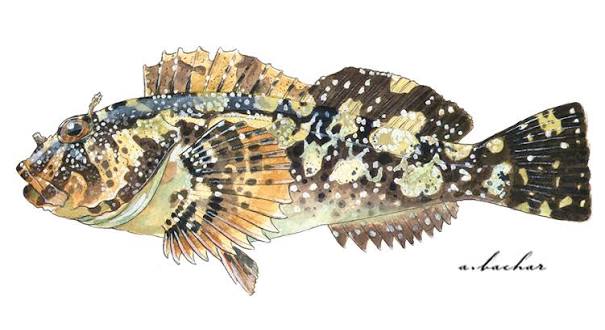
It is strange-looking, big-headed, mottled, patient, powerful, and perfectly designed for life on the rocks. It looks like a creature that was carved out of the reef itself. And that is exactly what makes it such a great reef dweller. The cabezon’s scientific name is Scorpaenichthys marmoratus. The word “cabezon” comes from Spanish and means “big head,” which is a perfect name for this fish. Its head is large, its mouth is wide, and its body is thick and rough-looking. It is not built for speed. It is built for patience, camouflage, and surprise.
The cabezon lives along the Pacific Coast, from Alaska down to Baja California. In Southern California, it is found around rocky reefs, kelp forests, jetties, tidepools, ledges, boulders, and areas with good structure. This makes it an important fish to understand in connection with artificial reefs.
A healthy artificial reef is not only for fast-swimming fish. It is also for the patient animals that hide, wait, protect eggs, hunt from the bottom, and become part of the reef’s hidden life. The cabezon is one of those animals.
A Fish Built for the Reef
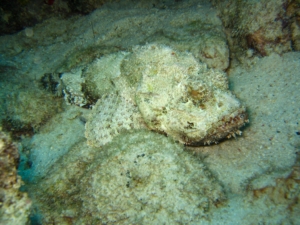
The cabezon is built like a rocky reef ambush machine. Its body is mottled with shades of brown, green, red, gray, cream, and darker blotches. This color pattern helps it disappear against rocks, algae, sand, and reef shadows.
A cabezon can sit almost motionless on the bottom and look like just another part of the reef. That camouflage is one of its greatest survival tools.
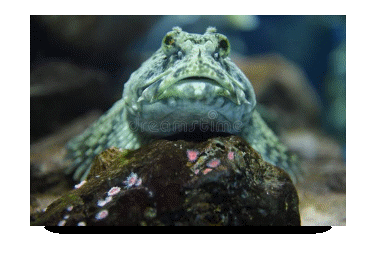
Small fish, crabs, shrimp, squid, and other animals may swim or crawl too close without realizing the cabezon is there. Then, in one quick movement, the cabezon opens its huge mouth and lunges. It does not chase prey for long distances. It waits. It watches. Then it strikes.
- This is called ambush predation.
In the reef world, ambush predators are very important. They help keep smaller animals in balance, and they add another level to the food web. A reef needs grazers, cleaners, swimmers, crawlers, filter feeders, scavengers, and predators. The cabezon is one of the reef’s patient hunters.
One of the most interesting things about the cabezon is that it has smooth skin without scales. This helps distinguish it from some other bottom fish, such as lingcod. Its skin and body shape give it a rough, ancient look, almost like a fish from another time.
And then there is the head.
The cabezon’s large head and wide mouth are not accidents. They are tools. A big mouth allows the fish to swallow large prey for its size. It can eat crabs, mollusks, small fish, shrimp, and other reef animals. In some places, cabezon are known for eating hard-shelled prey, which makes them an important part of the rocky reef community.
The cabezon may not win a beauty contest, but it is one of the most interesting fish on the reef.
- It is not flashy. It is effective.
From Tiny Larva to Reef Hunter
Like many ocean fish, the cabezon begins life very small.
Adult cabezon spawn during the cooler months. In California, spawning usually occurs from fall into winter, with eggs laid on rocky surfaces, often in crevices or protected places. The female lays a mass of eggs, and then something very interesting happens. The male guards them.
This makes the cabezon especially fascinating. In many fish species, eggs are released and left to drift or survive on their own. But male cabezon may stay near the egg mass, protecting it until the eggs hatch. This kind of parental care is important because eggs on the reef can be eaten by other fish, invertebrates, and hungry scavengers.
- A guarding male cabezon is like a reef father standing watch.
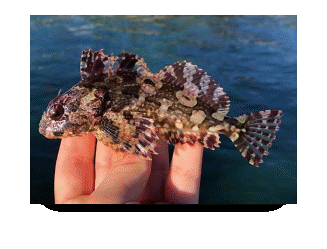
When the eggs hatch, the tiny young drift out into the water as larvae. For months, they live as part of the plankton, carried by currents and growing in the open ocean. Later, the young fish settle into shallow habitat such as tidepools, rocky areas, kelp beds, and reefs.
- This life story connects the open ocean to the reef.
A cabezon may start as a tiny drifting larva, then become a small fish hiding in shallow habitat, and eventually grow into a powerful bottom predator. At every stage, habitat matters. Young cabezon need places to hide. They need small cracks, algae, pools, rocky edges, and safe spaces where they can avoid being eaten. As they grow larger, they move into the reefs and kelp forests where they can hunt, hide, and reproduce.
- This is one of the reasons artificial reefs can be so important.
A good artificial reef creates structure. It creates cracks, ledges, surfaces, holes, shadows, and edges. These are not just interesting shapes. They are life-support systems for young fish and adult fish. For a young cabezon, structure is protection. For an adult cabezon, structure is a hunting ground.
A Fish With a Territory
The cabezon is a bottom-dwelling fish, which means it spends much of its time close to the seafloor. It does not usually travel around in big schools like some fish. It is more of a solitary reef resident. A cabezon may choose a rocky area, ledge, crevice, or patch of reef and stay close to that habitat. It rests on the bottom, blends into the reef, and waits for food to come within reach. This makes it a great example of why reef complexity matters.
A flat, empty seafloor does not offer the same opportunities as a rocky reef. A healthy reef has levels, caves, ledges, cracks, walls, sand channels, algae, and hiding places. Each part of that structure gives different animals a different way to live.
The cabezon uses the reef like a hunter’s blind. It sits still. It watches. It disappears into the background. Then, when the moment is right, it moves.
Because it lives close to the bottom, the cabezon is also part of the reef’s hidden world. Many people may swim over a reef and never see one. But a careful diver who looks closely at the rocks may suddenly notice a pair of eyes, a wide mouth, or a mottled body that was invisible a moment before. That is one of the joys of learning marine biology. The more you know, the more you see.
The Cabezon and Artificial Reefs
Artificial reefs are most successful when they provide real habitat, not just hard material. Fish and invertebrates move into a reef because the reef gives them something useful: shelter, food, shade, breeding space, hunting areas, and protection from predators.
The cabezon is exactly the kind of fish that shows why structure matters.
It needs rocky places to rest and hide. It needs reef edges where prey animals move. It needs crevices and surfaces where eggs can be laid. It needs habitat that supports crabs, shrimp, mollusks, small fish, and other prey. It needs a reef community. This makes the cabezon an excellent species to include in the AnEcoScape reef story.
A well-designed artificial reef in Southern California could provide the kind of habitat cabezon naturally use. It could create ledges, pockets, boulder fields, crevices, and surfaces that support algae and invertebrates. As the reef matures, more prey animals move in. As prey animals move in, bottom predators like cabezon may begin using the reef. That is how reef life expands and becomes diverse and grows, expanding the biosphere.
At AnEcoScape, the goal is not simply to place structures in the ocean. The goal is to help create a living reef communities. A reef that works for cabezon will likely work for many other animals as well: crabs, shrimp, juvenile fish, kelp bass, rockfish, octopus, lobsters, sheephead, and larger predators.
The cabezon may not be the most famous reef fish, but its presence would be a good sign:
- It would mean the reef has structure.
- It would mean the reef has prey.
- It would mean the reef has hiding places.
- It would mean the reef is becoming useful to the animals that actually live there.
In a way, the cabezon is like a quiet inspector of reef design. If the habitat is good, it may move in, settle down, and become part of the neighborhood.
A Hardy Fish Worth Protecting
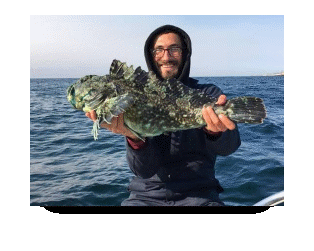
Cabezon are part of California’s nearshore fish community and is an important fish for both the ecosystem and people. It is valued by recreational and commercial fishermen, and it is known as good eating. But like all reef fish, it needs to be managed carefully. They do not grow as old as giant sea bass, but they still need time to mature, reproduce, and contribute to the population. Because they live near reefs and rocky habitat, they can be vulnerable to fishing pressure in popular coastal areas.
This is why fishing regulations, size rules, seasonal protections, and marine protected areas matter. They are part of how people and the ocean can have a better long-term relationship.
There is also one very important safety fact about the cabezon.
The meat of the fish is eaten by people, but the eggs, also called roe, can be poisonous to humans. This is a strange and memorable fact, and it reminds us that the natural world is full of surprises. An animal can be beautiful, useful, delicious to some people, ecologically important, and dangerous in one specific way, all at the same time.
The cabezon also has another unusual feature: it lacks a swim bladder. Many bottom fish can suffer from barotrauma when brought up from deeper water because gases expand inside the swim bladder. The cabezon does not have this structure, which makes it different from many other bottom-dwelling fish. Again, this fish is strange in the best possible way. It is one of those reef animals that becomes more interesting the more you learn about it.
Why This Fish Matters
The cabezon matters because it teaches us to look more carefully.
Some reef animals announce themselves with bright colors, fast swimming, or dramatic size. The cabezon does the opposite. It hides. It waits. It blends in. It becomes part of the reef until the reef seems to come alive. That is an important lesson.
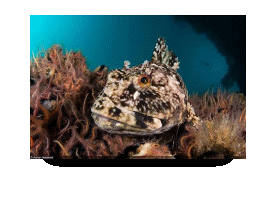
A healthy reef is not only made of the animals we notice first. It is also made of the animals that live in the shadows, under ledges, inside cracks, and along the bottom. The hidden animals are just as important as the famous ones.
The cabezon is part of the reef’s balance. It is a predator, a nest guardian, a bottom dweller, and a sign that rocky habitat is doing its job. It connects the reef surface to the food web. It reminds us that rocks, caves, ledges, and crevices are not empty spaces. They are homes.
For young people, the cabezon is a wonderful fish to study because it is unusual, funny-looking, powerful, and full of surprises. It invites curiosity. Why is its head so big? Why does it have no scales? Why does it sit still? Why are its eggs poisonous? Why does the male guard the nest? How can a fish disappear right in front of your eyes?
These are the kinds of questions that can lead a young person toward marine biology. For AnEcoScape, the cabezon represents the importance of designing reefs that work for real animals. If we want life to return, we have to think like the animals that will live there. We have to create shelter for the shy ones, hunting grounds for the patient ones, nursery spaces for the young ones, and surfaces where the whole reef community can begin.
One day, a young diver may swim over an AnEcoScape reef and suddenly notice something watching from the rocks:
- A wide mouth.
- A giant head.
- A pair of patient eyes.
- A fish that looked like stone until it became alive.
- That fish may be a cabezon.
And in that moment, the reef will have done something powerful. It will have created wonder.
Patrick Dean
Associate Writer and Board Member of AnEcoScape NPO
Patrick Dean is a Life Coach and his work has taken him all over the world and is a strong advocate in preserving our shores, oceans, and aquatic life. Patrick was also a fishing boat captain for over 13 years.
Patrick Dean’s Website
AnEcoScape is a Non-Profit 501(c)(3) Organization. Our mission is to educate, improve, and restore the health, productivity, and diversity of the near shore marine life and nearby terrestrial areas, which are rapidly degrading from human activities.
If you like this article, please give us a small contribution by making a Donation to AnEcoScape to support our cause.