Dwellers of the Reef:
The California Two-Spot Octopus: The Reef’s Shape-Shifting Genius, With a Short but Exciting Life.
Scientific name: Octopus bimaculoides. Also known as: The “Bimac”
Imagine you are swimming across a Southern California reef and seeing a small pile of mottled rocks. You look away. You look back.
The rocks have grown eight arms—and are crawling away !
Meet the California two-spot octopus, one of the most intelligent, adaptable, curious, and downright astonishing animals living along our coast. The “bimac,” as researchers and octopus enthusiasts often call it, lives along the California and Baja California coastline, inhabiting shallow rocky areas where caves, cracks, ledges, and other hiding places provide good octopus real estate.
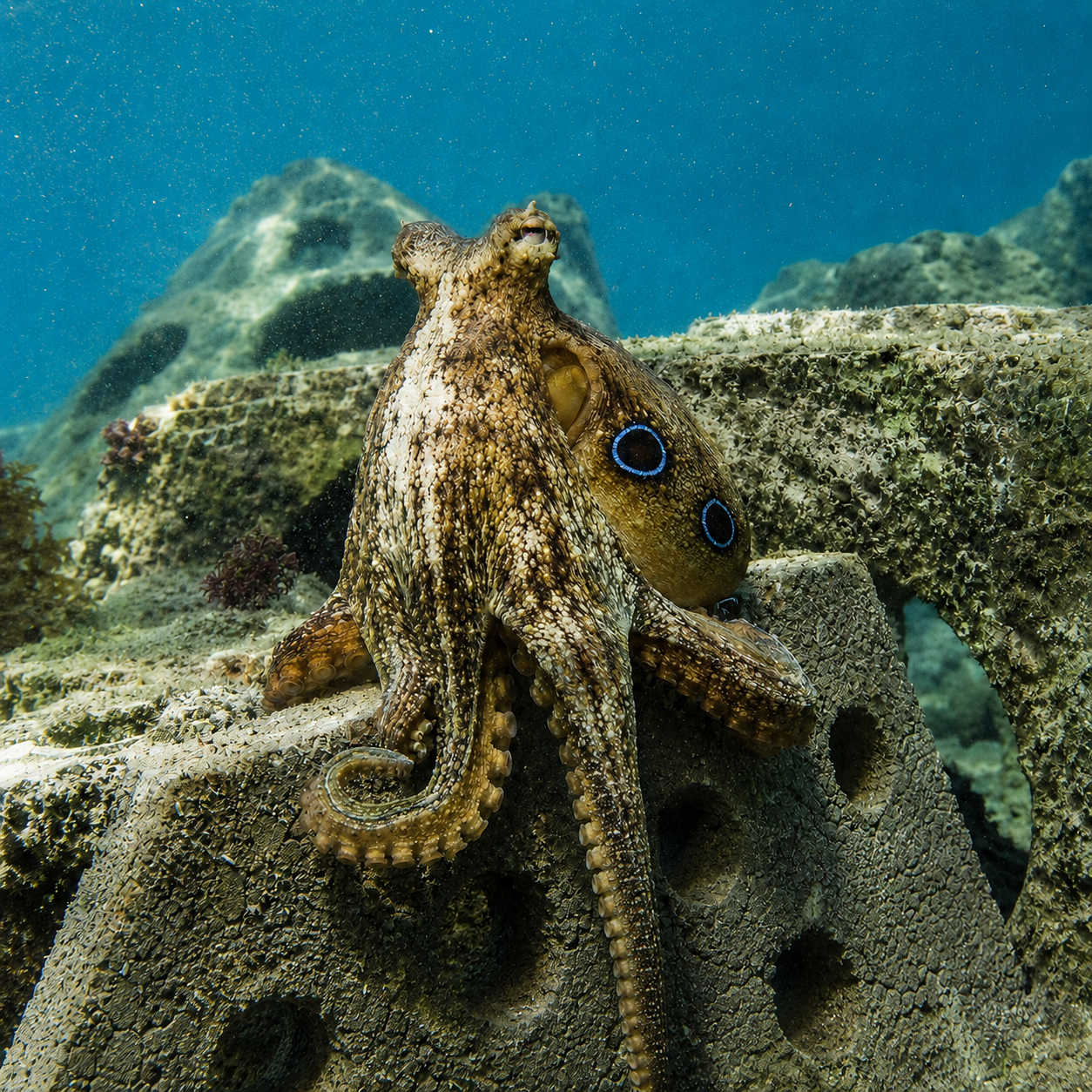
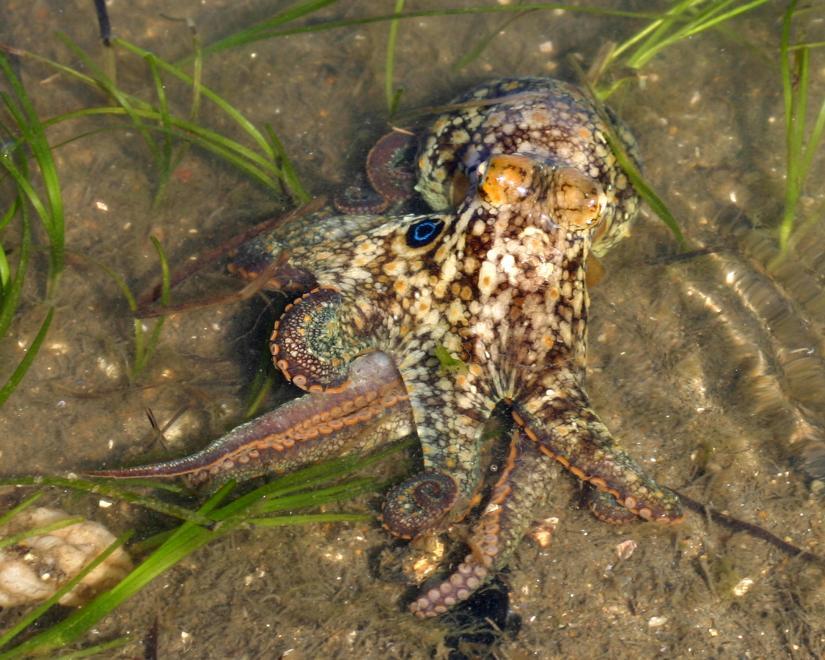
And once you know what to look for, there is one feature that can give away even this master of disguise: a beautiful blue-ringed spot on each side of its body, just below the eyes. Those spots resemble another pair of eyes and may help confuse or intimidate a potential predator. But the two blue spots are only the beginning of what makes this animal extraordinary.
The Animal That Can Almost Disappear
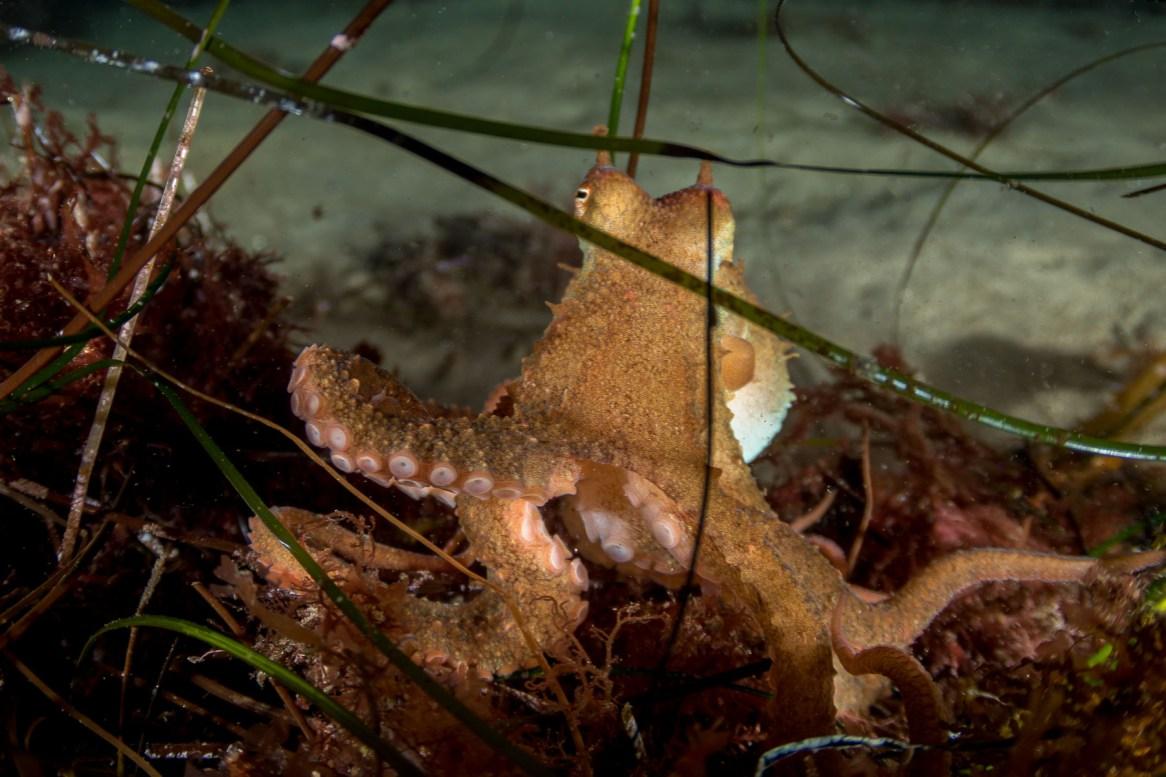
A bimac doesn’t simply hide behind something. It can become part of the scenery. As it moves across sand, stone, algae, shells, or reef, specialized structures in its skin allow it to rapidly change its color, pattern, and even apparent texture. One moment it may appear pale and smooth. Seconds later it can become dark, mottled, rough, and remarkably similar to the rocks beneath it.
The secret lies in tiny pigment organs called chromatophores, which work with other reflective structures and muscles in the skin. The result is one of the most sophisticated camouflage systems found anywhere in the animal kingdom. This isn’t just a cool party trick. Camouflage helps the octopus hide from predators, sneak up on prey, and move through a dangerous world without advertising where it is. And here is something almost unbelievable. Think about that for a moment. This is an animal whose disguise system is so sophisticated that the skin itself can detect light.
Smart Enough to Remember—and Curious Enough to Play
If camouflage were the bimac’s only superpower, it would already deserve a place among the reef’s most remarkable animals. But then we get to its brain.
Octopuses have the largest and most complex nervous systems among invertebrates, and the California two-spot has become an important species for scientists studying how such an unusual nervous system evolved. In fact, O. bimaculoides was the first octopus to have its genome sequenced.
Researchers have also found impressive evidence of learning and memory. In one experiment, California two-spots explored an unfamiliar area and learned the location of a hiding place. They could remember spatial information days later—and some retained what they had learned for at least a week. But maybe even more delightful is this:
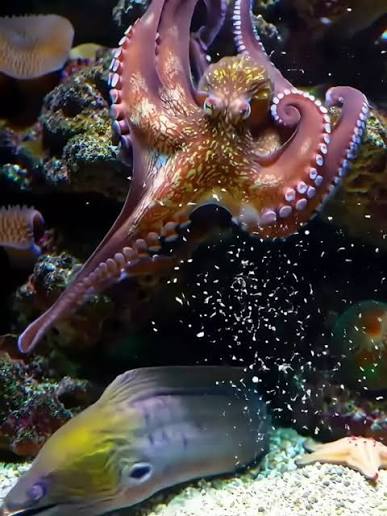
They appear to play.
A recent study of California two-spots documented behavior consistent with scientific definitions of animal play. Some octopuses repeatedly manipulated objects even when doing so served no obvious immediate purpose. Researchers also noticed differences between individuals: some were curious and interactive, while others preferred to retreat to their dens.
Yes—octopuses seem to have personalities.
Scientists studying young bimacs have detected differences in traits such as active engagement, readiness, aggression, and avoidance when the animals were only about three weeks old.
So the little octopus looking back at you from beneath a rock may not simply be “an octopus.” It may be a particularly bold octopus. Or a cautious one. Or perhaps the curious one in the neighborhood.
Eight Arms, One Very Effective Hunter
When hunting, the bimac becomes a beautifully coordinated combination of eyes, arms, suckers, camouflage, patience, and speed.
Its menu includes crabs, shrimp, mollusks, and other small marine animals.
Researchers watching California two-spots hunt discovered that they can even change their attack strategy depending upon the prey.
When attacking crabs, they tended to use a fast, coordinated strike involving several arms. When hunting shrimp, they could use slower stalking movements and different arm sequences.
In other words: Different problem. Different strategy.
That behavioral flexibility is exactly what makes the octopus such a fascinating predator.
Bimacs are often most active at night, venturing from the security of a den to explore and hunt. Rocky reefs are especially valuable because all those cracks, holes, ledges, and protected spaces provide places to retreat from predators. And if you happen to be a crab wandering around after dark…
you may want to keep moving.
A Remarkably Short Life
Here is one of the strangest things about the California two-spot. For an animal capable of so much learning, exploration, and behavioral sophistication, its life is surprisingly short. A bimac generally lives only about one to one-and-a-half years in the wild, although individuals under human care may live longer. Its entire life happens quickly: Grow. Explore. Learn. Hunt. Avoid becoming dinner. Mate. Reproduce. And then the life cycle comes to an end. Like most octopuses, the bimac is semelparous, meaning reproduction occurs only once during its life.
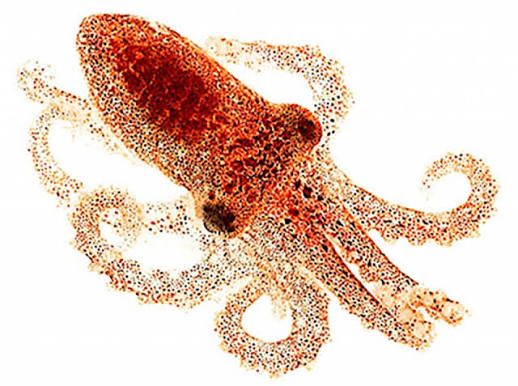
The female retreats to a protected den and attaches her eggs in clusters. Unlike many octopus species that produce tens of thousands of tiny eggs, O. bimaculoides produces roughly 137 to 841 relatively large eggs. She then becomes one of the ocean’s most dedicated mothers.
She remains with the eggs, protecting and tending them and circulating oxygen-rich water around them. And she stops eating.
Her body gradually enters a natural period of decline called senescence, controlled in part by remarkable hormonal changes involving organs called the optic glands. Eventually, after completing her final responsibility to the next generation, she dies. It is one of the ocean’s most extraordinary examples of parental investment.
Born Ready
And now comes another fascinating difference between the bimac and many other octopuses. When the eggs finally hatch, the babies don’t emerge as microscopic larvae that must drift helplessly through the open ocean.
- They hatch as fully formed miniature octopuses.
- They can crawl.
- They can hunt.
- They can change their body patterns.
And from almost the beginning, they must start figuring out the world around them. There is no long childhood here. When you’re a bimac, life starts immediately.
Why Artificial Reefs are important to the Bimac
This is where the California two-spot becomes especially interesting to us at AnEcoScape. Bimacs depend heavily on structure. They use rocky habitat, ledges, holes, and crevices as shelters and dens. Research has even shown that when suitable dens are limited, California two-spots will compete for the better ones. That makes the physical design of an artificial reef important.
A reef isn’t valuable simply because something solid has been placed on the seafloor. A successful reef can create complexity—different-sized openings, sheltered spaces, surfaces for marine life to colonize, feeding areas, and places where animals can escape predators. Research with other octopus species has demonstrated that octopuses readily occupy properly designed artificial reef cavities and artificial dens.
We cannot promise that a California two-spot will immediately move into every AnEcoScape reef we build. Octopuses, after all, make their own decisions.
But if we create the kind of complex reef habitat these animals naturally seek—complete with protected spaces, abundant prey, and plenty of places to explore—we may be creating some very attractive new underwater neighborhoods for bimacs. And wouldn’t that be something?
A reef that begins as an idea … becomes structure … the structure becomes habitat … marine plants and animals begin arriving…
and one evening, from inside a newly occupied crevice, two brilliant blue spots appear.
The bimac has moved in.
The California two-spot octopus reminds us that a reef is far more than rocks beneath the water. It is a neighborhood. A hunting ground. A nursery. A hiding place. And for animals like the bimac, it is a constantly changing world to explore, learn, and survive in. Perhaps that is what makes this creature so captivating. We recognize something in its curiosity.
- It investigates.
- It learns.
- It adapts.
- It remembers.
- It plays.
And when the environment changes… the bimac changes with it. That is one remarkable Dweller of the Reef.
Patrick Dean M.A.
Associate Writer and Board Member of AnEcoScape NPO
Patrick Dean is a Master Career and Business Advisor and Corporate Trainer. His work has taken him around the world, and he strongly advocates for preserving our shores, oceans, and aquatic life. Patrick also served as a fishing boat captain in San Diego for over 13 years.
Patrick Dean’s Website
AnEcoScape is a Non-Profit 501(c)(3) Organization. Our mission is to educate, improve, and restore the health, productivity, and diversity of the near shore marine life and nearby terrestrial areas, which are rapidly degrading from human activities.
If you like this article, please give us a small contribution by making a Donation to AnEcoScape to support our cause.