Great Reef Dwellers: Nudibranchs, the Living Jewels of the Reef
By Patrick Dean. August 7, 2026
When we think about reef dwellers, we often think about fish, lobsters, octopus, or sea stars. But some of the most beautiful animals on a reef are much smaller, slower, and easier to miss.
- They do not roar through the kelp like white seabass.
- They do not hide under ledges like spiny lobsters.
- They do not stare at you with a giant grumpy face like a cabezon.
- They glide quietly over rocks, algae, sponges, hydroids, and reef surfaces.
- They look like tiny dragons, flowers, ribbons, fireworks, or living pieces of art.
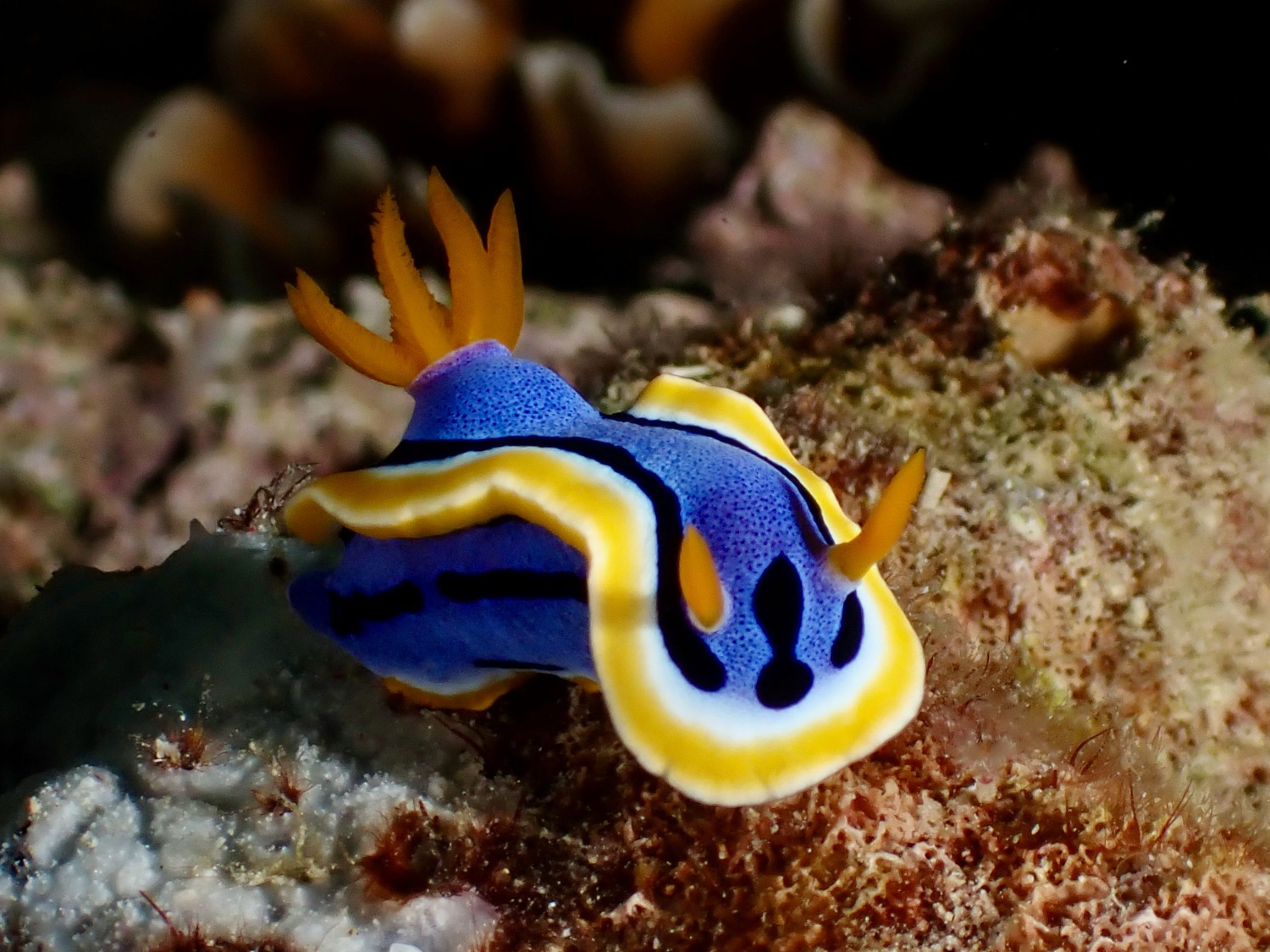
- These animals are called nudibranchs.
Nudibranchs are soft-bodied marine mollusks. They are related to snails, clams, mussels, octopus, and squid. People often call them sea slugs, although not all sea slugs are nudibranchs. A good simple way to think about it is this: all nudibranchs are sea slugs, but not all sea slugs are nudibranchs.
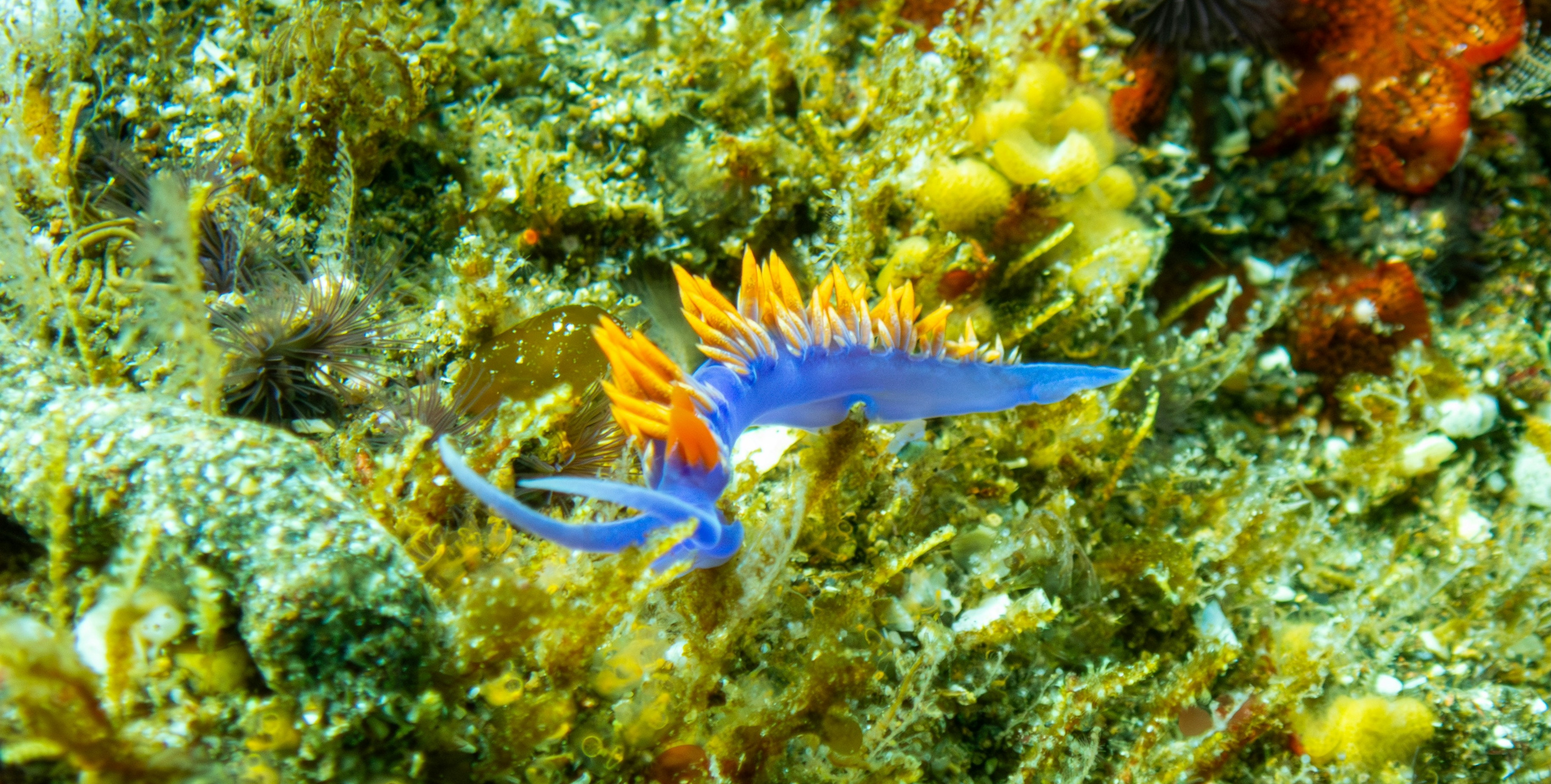
The word “nudibranch” means “naked gill.” That name comes from the fact that many nudibranchs breathe through exposed gills on their backs. They do not have the hard adult shell we usually expect from a snail. Most begin life with a tiny shell as larvae, but they lose it as they grow. That might sound like a bad idea. After all, if you are a soft little animal crawling around on a reef full of hungry fish, crabs, sea stars, and anemones, wouldn’t you want armor?
Apparently, nudibranchs had another plan. Instead of relying on shells, many nudibranchs use camouflage, bright warning colors, chemical defenses, or even stolen stinging cells from the animals they eat. In other words, they may look delicate, but many of them are tougher than they appear.
- A nudibranch is not just a pretty sea slug.
- It is a tiny reef specialist with a surprising set of tools.
A Creature Built for the Reef
Nudibranchs are built for life on surfaces.
They crawl across rocks, kelp, algae, sponges, bryozoans, tunicates, hydroids, and other animals that grow on reefs. They move slowly, but they are often highly specialized hunters or grazers. Many nudibranchs eat very specific foods. One species may feed mainly on sponges.
Another may feed on hydroids. Another may eat bryozoans, anemones, eggs, or even other nudibranchs. This makes them fascinating animals for divers and marine biologists. If you find a nudibranch, it often tells you something about the reef. It may mean that its favorite food is nearby. It may mean that the reef has enough growth, complexity, and small life to support specialized animals. A nudibranch is like a colorful clue on the ocean floor.
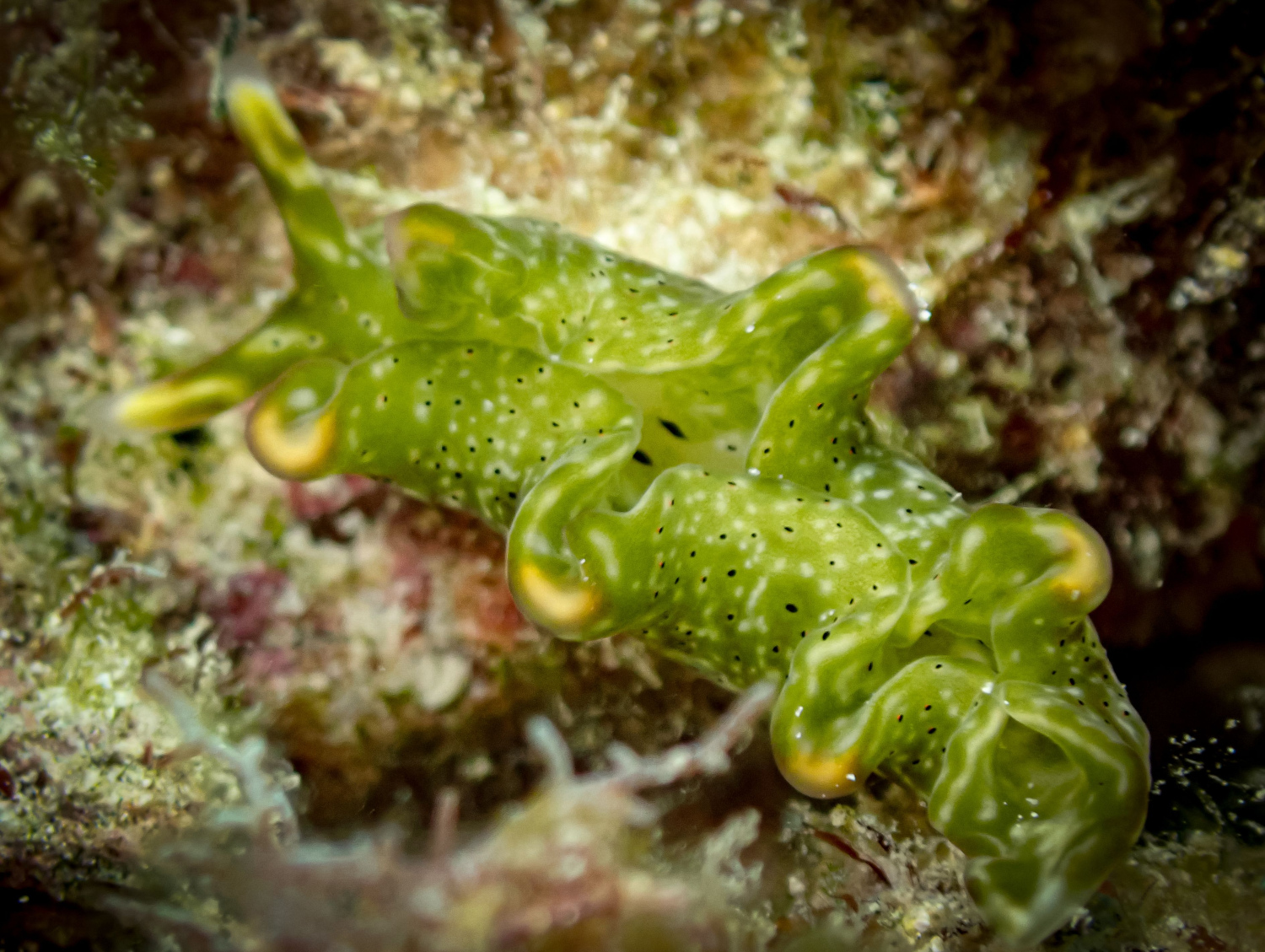
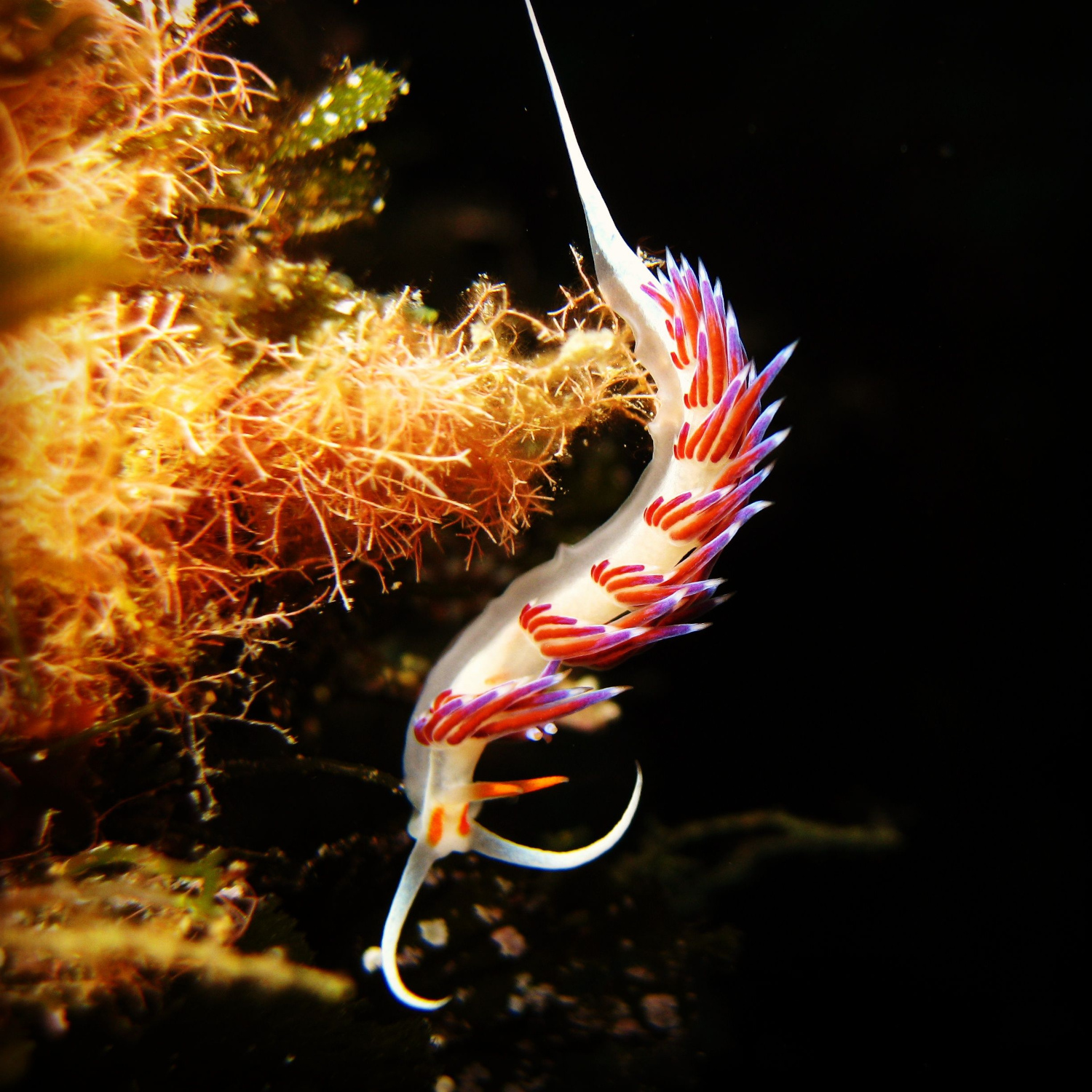
Nudibranchs have simple eyes that mostly detect light and dark. They are not looking around the reef the way a fish or octopus might. Instead, they rely heavily on chemical sensing. Those two horn-like structures on their heads are called rhinophores. Rhinophores help them detect chemicals in the water. They can help a nudibranch find food, locate a mate, and understand the world around it. Basically, a nudibranch smells its way through the ocean. Some nudibranchs also have feathery gills on their backs. Others have finger-like structures called cerata. Cerata can help with breathing, digestion, and defense. In some species, cerata are brightly colored and make the animal look like a tiny underwater flame.
One of the most amazing defense tricks belongs to certain nudibranchs that eat hydroids or anemones. These prey animals have stinging cells. Instead of being harmed by them, some nudibranchs can store the unfired stinging cells in the tips of their own cerata and use them for protection.
- Imagine eating a cactus and then using the cactus spines as armor.
That is the nudibranch way!
From Tiny Larva to Living Art
- Every nudibranch begins life very small.
Many nudibranchs hatch from egg ribbons or coiled egg masses laid on rocks, algae, eelgrass, or the same animals they feed on. These egg ribbons can be beautiful in their own right, sometimes looking like delicate spirals, ribbons, or tiny coils of lace.
After hatching, many nudibranchs spend part of their early life as tiny drifting larvae in the plankton.
At this stage, they may have a small shell. Later, they settle onto the seafloor, lose the shell, and transform into the soft-bodied animals we recognize as nudibranchs.
- This is one of the magical parts of reef life.
A creature that may one day look like a pink flower or a purple dragon begins as something almost invisible, floating in the water with the currents. Eventually, the young nudibranch must find the right place to settle. That usually means it needs the right habitat and the right food. If the young nudibranch eats a certain sponge, hydroid, bryozoan, or tunicate, then it needs to land where that food exists.
This is why reefs matter.
- For a young nudibranch, structure is not just shelter.
- Structure is food.
- Structure is a place to grow; structure is the beginning of a life.
A flat, empty bottom does not offer much for nudibranchs. But a reef covered with life—sponges, algae, hydroids, bryozoans, tunicates, and small invertebrates—can become a whole world for them.
A Slow Explorer With Favorite Foods
- Nudibranchs are not fast animals.
No one has ever looked at a nudibranch and said, “That thing is making great time.”
They move slowly over the reef, using a muscular foot on the underside of the body. But slow does not mean simple. Nudibranchs are careful, specialized, and surprisingly effective.
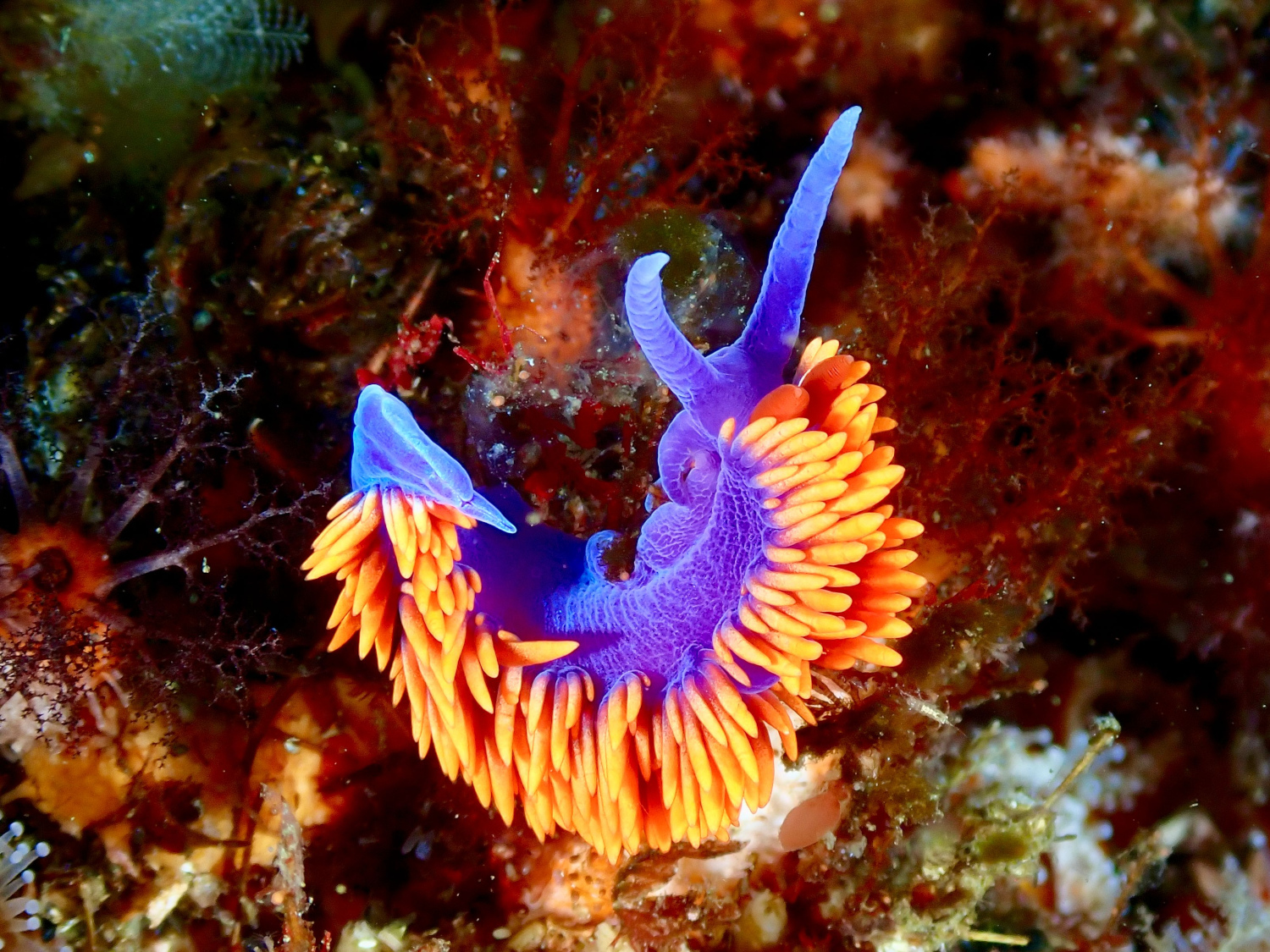
Many species are picky eaters. Some are so closely tied to one type of prey that finding the prey may help you find the nudibranch. For example, some Southern California nudibranchs are associated with bryozoans, hydroids, sponges, or anemones. Others appear in greater numbers when their food becomes abundant.
- A reef that first looks like rock and seaweed begins to reveal hidden life.
- A little patch of color may turn out to be a nudibranch.
- A tiny pair of rhinophores may appear.
- A flower-like shape may move.
This is one of the reasons nudibranchs are so good for young people to learn about. They reward curiosity. They teach careful observation. They show us that nature is not only grand and dramatic. It is also small, strange, and full of surprises.
The ocean does not reveal everything at once. Sometimes you have to look slowly.
Nudibranchs and Artificial Reefs
- Artificial reefs are most successful when they become living surfaces.
Fish and lobsters may be the animals people notice first, but much of the real reef-building story begins with smaller life. Algae attach. Kelp spores settle. Sponges grow. Hydroids spread. Bryozoans form colonies. Tunicates filter the water. Tiny animals move in. The reef surface becomes covered with living material.
- That is the world nudibranchs need.
Nudibranchs do not move into a reef because humans call it a reef. They move in because the reef has become alive enough to support them. They need surfaces to crawl on, food to eat, and a small community of organisms that have already begun growing there. This makes them very important for the AnEcoScape story. When an artificial reef is first placed in the ocean, it is mainly structure. Over time, it can become habitat. The arrival of nudibranchs can be a sign that the reef is developing the smaller layers of life that support a healthy ecosystem.
- They may not be big like giant sea bass.
- They may not be commercially famous like lobster.
- They may not be prized game fish like white seabass.
But nudibranchs help show that the reef is becoming biologically rich. A reef with nudibranchs is a reef where small life is happening.
And small life matters. Small animals feed larger animals. Filter feeders clean the water. Sponges, hydroids, bryozoans, and tunicates create habitat for other species. Nudibranchs feed on some of these organisms and become part of the balance.
- A healthy reef is not just a place with big fish.
- A healthy reef is a place where tiny specialists can survive.
Small Animals Worth Protecting
Most nudibranchs do not live very long compared with animals like giant sea bass or spiny lobsters. Some may live only months. Others may live about a year. Their lives are often short, but that does not make them unimportant. In fact, their short lives make them part of the fast-changing rhythm of the reef.
Nudibranch populations may appear, disappear, and reappear depending on food, currents, temperature, season, and habitat conditions. Sometimes a species may seem rare, and then suddenly many appear at once because conditions are right.
This can make nudibranchs exciting for scientists and divers.
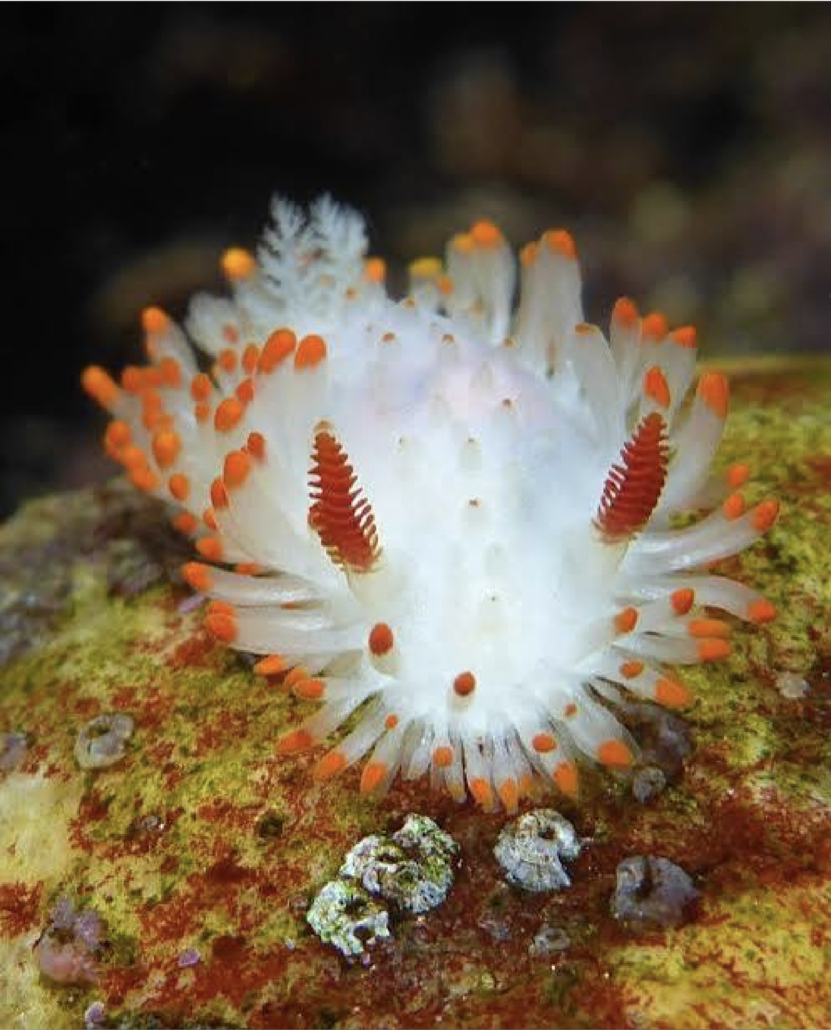
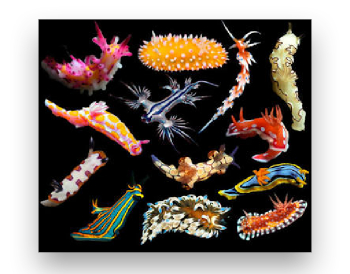
They remind us that the ocean is always changing. Southern California has many nudibranchs and sea slug relatives that divers and tidepool explorers may encounter. Some of the best-known include the Spanish shawl, the Hopkins’ rose nudibranch, the opalescent nudibranch, the sea lemon, and other colorful dorids and aeolids. Some are bright purple and orange. Some are pink. Some are white with black spots. Some are green, brown, or plain enough to disappear against the reef.
The bright ones get most of the attention, but the plain ones are just as important. Not every animal has to look like a parade float to matter.
Nudibranchs are also a reminder that protecting reefs means protecting more than the obvious animals. Clean water matters. Healthy kelp matters. Rocky surfaces matter. Sponges and bryozoans matter. Tiny invertebrates matter. If we want the colorful jewels of the reef, we have to protect the whole neighborhood.
Why These Animals Matter
Nudibranchs matter because they teach us to pay attention. They are hunters, grazers, chemical specialists, egg layers, reef crawlers, and living clues about the health and complexity of the reef.
- They are small, but they are not simple.
- They are soft, but they are not helpless.
- They are beautiful, but they are not only decorations.
For young scientists, nudibranchs are a perfect doorway into marine biology. They make us ask great questions. Why are they so colorful? How do they defend themselves without shells? What do they eat? Why do they have rhinophores? How can such a small animal be so strange and beautiful?
Those questions matter. They are the beginning of observation. They are the beginning of science. They are the beginning of wonder.
For AnEcoScape, nudibranchs represent one of the most important truths about artificial reefs: real restoration is not just about attracting big animals. It is about creating a living system from the smallest layers up.
A restored reef should have fish, lobsters, octopus, sea stars, kelp, algae, sponges, bryozoans, hydroids, tunicates, and tiny animals most people never notice.
And then, one day, a young diver may look closely at the reef and see a flash of purple, orange, pink, green, or white moving slowly across the rocks.
Patrick Dean
Associate Writer and Board Member of AnEcoScape NPO
Patrick Dean has a Masters in clinical psychology and is a Life Coach. His work has taken him all over the world and is a strong advocate in preserving our shores, oceans, and aquatic life. Patrick was also a fishing boat captain for over 13 years.
Patrick Dean’s Website
AnEcoScape is a Non-Profit 501(c)(3) Organization. Our mission is to educate, improve, and restore the health, productivity, and diversity of the near shore marine life and nearby terrestrial areas, which are rapidly degrading from human activities.
If you like this article, please give us a small contribution by making a Donation to AnEcoScape to support our cause.